


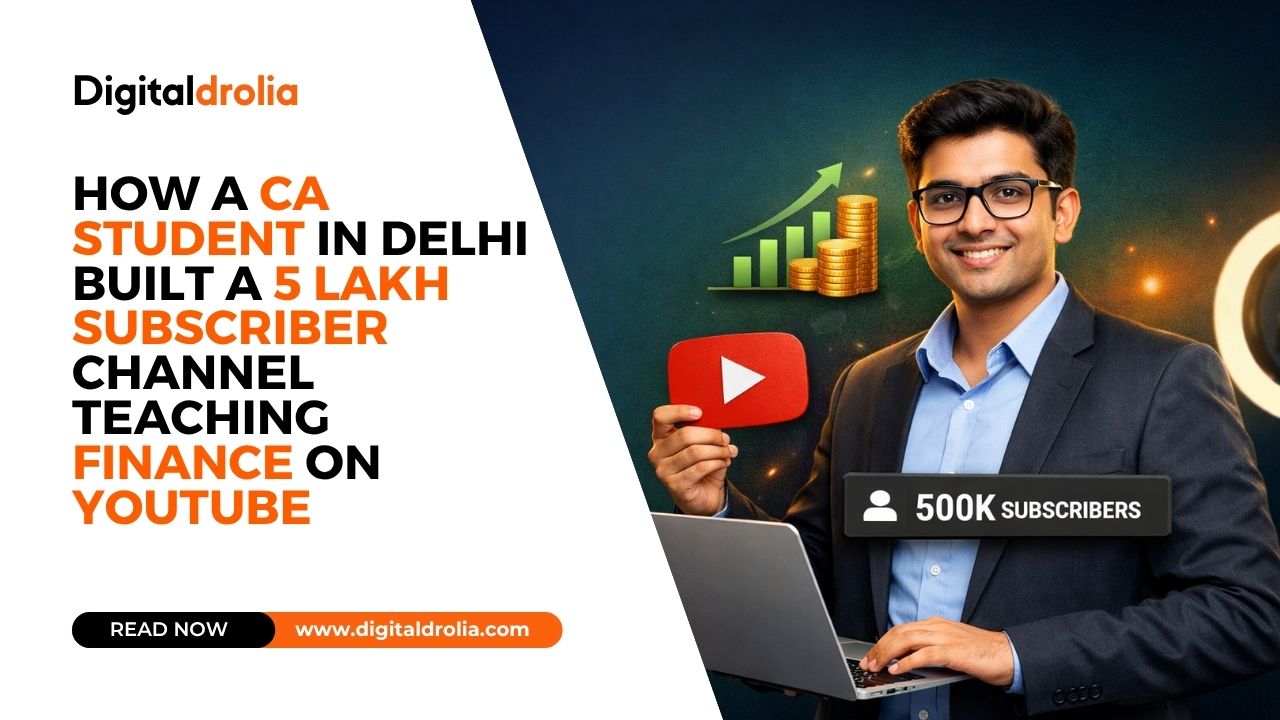
How a CA Student in Delhi Built a 5 Lakh Subscriber Channel Teaching Finance on YouTube

Let me tell you about a Sunday evening in a South Delhi flat that started something nobody expected — least of all the person sitting at the desk.
Arjit Saxena was twenty-three years old, in the third year of his CA intermediate preparation, and deeply frustrated.
Not frustrated with the syllabus — he actually liked the material. He liked the logic of taxation, the elegance of financial statements, the way accounting principles created a coherent picture of economic reality from a sea of transactions. What frustrated him was something else entirely.
He had been trying for weeks to explain a particular concept to his younger cousin — how deferred tax liability works, and why it appears in a company’s balance sheet even when no actual cash has changed hands. He had tried explaining it verbally. He had drawn diagrams on paper. He had sent his cousin excerpts from three different textbooks.
His cousin still did not understand it.

One evening, Arjit sat down and decided to try one more approach. He opened his laptop, propped it up on a stack of books to get the camera at eye level, and recorded himself explaining deferred tax liability the way he would explain it to a friend — using a real company as an example, drawing on a whiteboard he had bought for his own study sessions, breaking the concept down into the smallest possible pieces and then building it back up.
He uploaded the video to YouTube with essentially no planning — just his name as the channel name and a title that described exactly what the video covered: “Deferred Tax Liability Explained Simply — With Real Example.”
He shared the link with his cousin. His cousin watched it and immediately said he understood.
Arjit was mildly pleased and then forgot about the video entirely. He had CA exams to prepare for.
Six weeks later, he opened YouTube to watch something else and was surprised to see a notification. The deferred tax video had two thousand views. There were fourteen comments from people he had never met, thanking him for explaining something they had struggled to understand. One comment said it was the clearest explanation of deferred tax they had found on the entire internet in Hindi.
Arjit stared at the screen for a long moment.
Then he made another video.
That was three years ago. His channel now has five lakh — five hundred thousand — subscribers. It generates income that has made his CA income, when he eventually qualifies, a choice rather than a necessity. He has been cited by multiple CA coaching institutes as a supplementary resource. Students across India have passed exams with his videos as study material. And he still explains finance the way he would explain it to a friend.
This is his story. And it is one of the most practical, replicable blueprints for building a meaningful YouTube presence that exists — because it was not planned, not produced with expensive equipment, and not built on any advantage except the willingness to explain something he understood to people who did not.
The Beginning — What Made the First Video Work
Understanding why Arjit’s first video found an audience requires understanding the specific gap it filled — and why that gap was so significant.
Finance and accounting education in India, particularly at the CA level, has been dominated for decades by a specific pedagogical style. Dense textbooks written in formal, technical language. Classroom teaching that follows the textbook closely. Concepts explained through their definitions rather than through their logic. A culture in which confusion is sometimes treated as a personal failure rather than a reasonable response to inadequately explained material.
This system produces many technically competent accountants. It also produces — and this is the crucial part for our story — enormous numbers of students who have memorised concepts they do not truly understand. Students who can reproduce the definition of deferred tax liability but who could not explain what it means, why it exists, or how it would appear in the real accounts of a company they actually recognised.
Arjit’s video did not follow the textbook approach. It started from first principles — why does this concept exist? What problem does it solve? What would happen if it did not exist? — and built understanding from the ground up rather than asking the viewer to accept a definition and then learn to apply it.
This approach — building understanding rather than delivering definitions — was not a strategic choice Arjit made after researching his competition. It was simply how his mind worked. He could not teach a concept he did not genuinely understand, and he genuinely understood deferred tax liability well enough to explain why it made sense before explaining what it was.
The viewers who found that video were not looking for a different explanation of a concept they already understood. They were looking for the explanation that would finally make the concept click — and they had often tried multiple other sources before finding Arjit’s video. When it clicked for them, as it had for his cousin, they experienced not just comprehension but relief. And relief is one of the most powerful motivators for leaving a comment, sharing a link, and subscribing to a channel.
The first video worked because it solved a real problem that many people had — the problem of not actually understanding a concept that their exam required them to know. The format that solved it was not a production technique or a scripting method. It was genuine, first-principles explanatory depth combined with a clear, accessible voice that spoke to the student rather than over them.
The Three Months After the First Video — Building a Library Before Building an Audience

After the deferred tax video began accumulating views, Arjit made a decision that, in retrospect, was one of the most important strategic choices of his channel’s development — though at the time it was more instinct than strategy.
He did not try to capitalise immediately on the video’s unexpected success by posting every day. He did not reach out to other creators for collaborations. He did not spend money on promotion. He did not even set a posting schedule.
What he did was continue making videos about concepts he genuinely understood and that he had encountered confusion about — either in his own studies or in conversations with fellow students.
Over the three months following the first video, he posted twelve more. Each one followed the same approach: a genuine conceptual explanation built from first principles, using real examples, in conversational Hindi, on the whiteboard.
The topics were driven by a simple question he kept asking himself: what did I find confusing about this when I first encountered it, and what finally made it click?
This question was an extraordinarily good content strategy, as it turned out. Because what Arjit found confusing was, almost without exception, also confusing for the hundreds of thousands of other CA students in India who had been through or were going through the same syllabus. His confusion was their confusion. His clarity was their relief.
The twelve videos he posted in those three months did not go viral. They did not generate dramatic subscriber growth. But they did something more important: they created a body of work that began to establish Arjit’s channel as a specific, trustworthy resource for CA students who were struggling with specific conceptual difficulties.
When a student searched YouTube for “how to understand deferred tax liability” or “goodwill impairment explained” or “difference between cost of equity and WACC,” Arjit’s videos began appearing in results. And because the videos were longer and more thorough than competing content — answering not just what the concept was but why it existed and how to think about it — viewers watched more of each video. YouTube’s algorithm noticed. The videos began appearing more often in search results. More students found them. More subscribed.
This is the search engine model of YouTube growth that we discussed in our previous post. Arjit was building a library of searchable resources, each solving a specific problem for a specific searcher. The audience growth followed the library growth — slowly at first, and then with increasing momentum as the library became large enough to be a genuinely comprehensive resource for a specific audience.
The Twelve-Month Mark — When the Algorithm Started Working for Him
At the twelve-month mark of consistent posting, Arjit had approximately forty videos on his channel and around eight thousand subscribers. By any conventional measure of YouTube success, this was modest.
But something significant was happening beneath the surface that the subscriber count did not fully reflect.
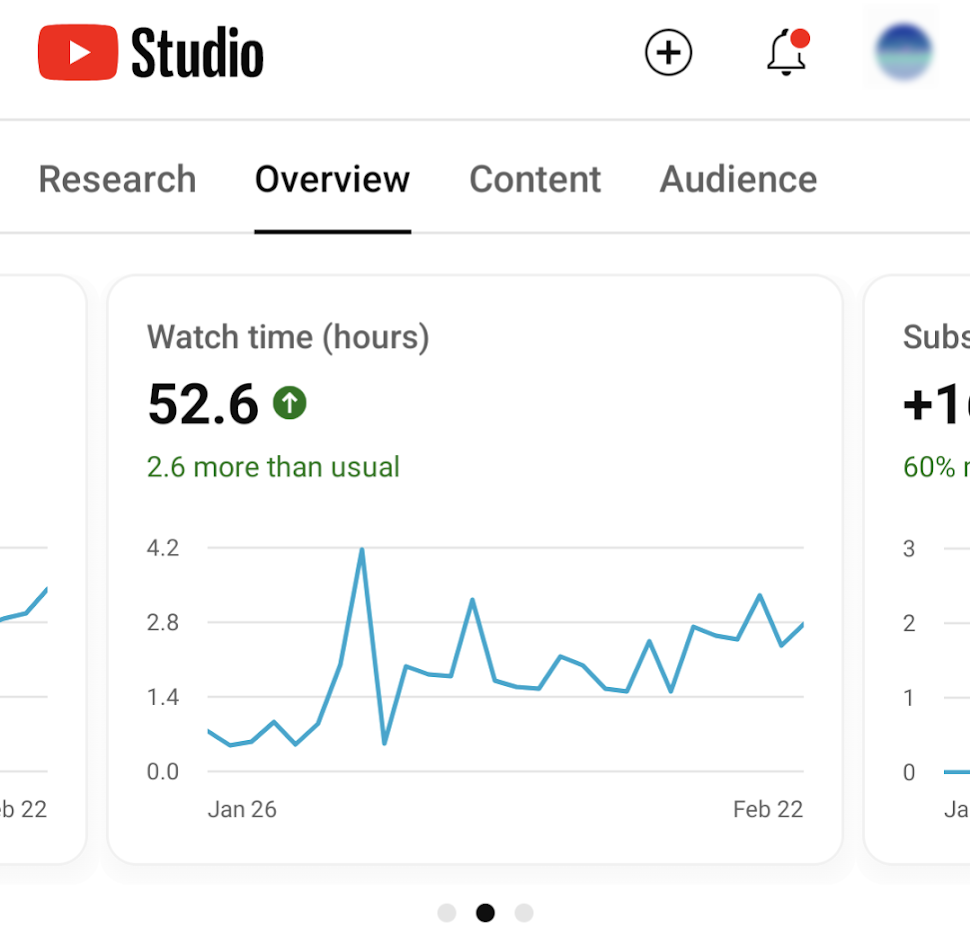
His videos were accumulating views not just in the week of upload — the typical pattern for social media content — but continuously, month after month. The deferred tax video was still getting daily views eighteen months after upload. A video on how to interpret a cash flow statement was picking up views from students who were encountering the topic for the first time, regardless of when Arjit had made it.
The library was compounding. Each new video added to the search discovery surface of the channel. And each video that continued accumulating views contributed to YouTube’s assessment of Arjit’s channel as a trustworthy, relevant source for finance education searches.
This is the mechanism by which YouTube channels in education and information categories often grow: not through viral moments or explosive subscriber spikes, but through the gradual accumulation of search authority — the patient building of a library that becomes progressively harder to ignore when someone searches for the topics it covers.
At the fifteen-month mark, a video Arjit had made about how to read a company’s annual report — a topic he chose because he had found it genuinely confusing in his first year of CA studies — began performing well beyond his existing subscriber base. The video was over an hour long — a deliberate choice because the topic genuinely required that time to cover properly, and because Arjit had found that viewers who came to his channel came specifically to understand things thoroughly rather than superficially.
YouTube, noticing that viewers were watching significant proportions of the hourlong video rather than abandoning it quickly, began recommending it to people who had watched similar finance content from other channels. The video reached people who had never heard of Arjit’s channel — and a meaningful proportion of those people subscribed.
By month eighteen, he had forty thousand subscribers. By month twenty-four, one lakh — one hundred thousand. The growth that had been slow and steady for the first year was accelerating.
What He Did Differently — The Decisions That Compounded
Arjit’s channel growth was not accidental. Looking back across three years, several consistent decisions shaped its trajectory in ways that are instructive for any creator in any educational category.
He prioritised understanding over coverage
The most common approach to educational YouTube content — particularly exam-focused content — is coverage: getting through as much of the syllabus as possible in as many videos as possible, at whatever depth the time allows.
Arjit took the opposite approach. He made fewer videos but made each one do more work — spending the time required to build genuine understanding rather than moving quickly through material.
This decision had a counterintuitive effect on his search performance. Because his videos were longer and more thorough than competing content on the same topics, viewers watched more of them. Higher average view duration told YouTube’s algorithm that this content was genuinely valuable. The algorithm rewarded the thoroughness with more distribution.
It also had a compounding effect on viewer loyalty. A student who watched an Arjit video and genuinely understood a concept they had been confused about did not just passively subscribe. They became an active advocate — sharing the video with classmates, recommending the channel in study WhatsApp groups, leaving comments that functioned as testimonials for future visitors.
This word-of-mouth among CA students became one of the most significant drivers of channel growth, and it was built entirely on the reputation for genuine explanatory depth.
He stayed in his lane with extraordinary discipline
Arjit’s channel covers finance and accounting. It does not cover general life advice. It does not cover personal development or productivity. It does not cover stock tips or investment recommendations. It does not cover anything that was not directly relevant to financial understanding.
This discipline was not instinctive — there were moments when he was tempted to make content that felt more immediately popular, broader in appeal, easier to make. But he consistently returned to the discipline of staying within the specific subject matter he genuinely understood deeply.
The result was a channel whose recommendation profile within YouTube’s algorithm became progressively sharper over time. YouTube learned, from the behaviour of Arjit’s viewers, that his content was specifically valuable to finance students — and it recommended his videos with increasing accuracy to exactly that audience.
A channel that covers everything signals to the algorithm that it covers nothing in particular. A channel that covers one specific area deeply signals that it is a trusted resource for that area — and the algorithm responds accordingly.
He made the content for the student, not for the examiner
A significant portion of CA education content on YouTube is effectively structured around what the examiner expects — how to answer a question in a way that earns marks, rather than how to understand the underlying concept. This approach makes pedagogical sense in a context where the goal is exam performance, but it produces content that is genuinely useful only to students preparing for that specific exam.
Arjit’s content was structured around conceptual understanding first. He explained concepts in ways that would be useful not just for passing the CA exam but for actually working as an accountant — for reading real financial statements, for advising real clients, for understanding real business situations.
This broader relevance gave his content an audience beyond just CA students. Working professionals who wanted to understand financial concepts. Business owners who wanted to read their own accounts more intelligently. MBA students encountering finance for the first time. Finance enthusiasts who wanted to understand the material they were reading in the financial press.
None of these audiences were the ones Arjit had in mind when he started. But because his content was built on genuine understanding rather than exam technique, it served them naturally. And serving multiple adjacent audiences — all of them searching for financial understanding from different starting points — created a more robust and diverse subscriber base than a purely exam-focused channel would have produced.
He was consistent without being mechanical
Arjit posts approximately two to three videos per week. This consistency has been maintained across three years without a significant gap.
But the consistency is not mechanical — he does not post on a rigid schedule because the schedule demands it. He posts when he has something genuinely worth explaining. If a video takes an extra week because the concept requires more preparation, it takes an extra week.
This approach to consistency — regular enough that viewers know new content is coming, but quality-driven rather than schedule-driven — means that every video Arjit posts represents something he genuinely wanted to explain. This is visible in the content — there is a quality of genuine engagement in his explanations that is different from the slightly tired, going-through-the-motions quality that appears in creators who are posting to schedule regardless of whether they have something real to say.
Viewers sense this distinction even when they cannot articulate it. The channel feels alive rather than automated.
The Monetisation Reality — How the Channel Became a Business
At approximately the two-lakh subscriber mark, Arjit’s channel had become genuinely financially significant. Understanding how the money works — and how it scaled — is one of the most practically valuable aspects of this story for any creator considering a similar path.
YouTube AdSense
AdSense revenue — the money YouTube pays creators for the advertisements shown on their videos — was the first income stream to materialise and remains a consistent component of total channel revenue.
For finance content, AdSense rates are significantly higher than average YouTube rates. Finance is one of the highest-CPM (cost per thousand views) categories on YouTube, because the advertisers competing for that audience — banks, insurance companies, investment platforms, financial services of all kinds — are willing to pay premium rates to reach people who are actively engaging with financial content.
A channel with five lakh subscribers covering finance education, generating several million views per month across its library of videos, produces meaningful AdSense revenue — enough to be a primary income source in its own right.
Brand partnerships

As the channel’s subscriber count and reputation grew, brands began approaching Arjit with partnership proposals. Finance-adjacent products — accounting software, financial planning apps, online learning platforms, investment products — found in Arjit’s channel an audience that was highly relevant to their offerings and a creator whose credibility with that audience was established and trusted.
Brand partnerships, when chosen carefully and disclosed transparently, became a significant revenue stream. Arjit is selective — he works only with products he genuinely uses or believes in, because his channel’s credibility with an analytically sophisticated audience is the asset that makes the partnerships valuable in the first place. Compromising that credibility for a partnership fee would be a bad trade.
Paid courses and study materials


Perhaps the most direct expression of the channel’s educational mission is a suite of paid courses and study materials Arjit has developed — extended, structured treatments of topics that the free YouTube videos introduce. These products allow students who want to go deeper to pay for a more comprehensive learning experience.
This revenue stream is particularly well-suited to educational channels because it monetises the specific audience most motivated by the channel’s content — the students who are most serious about understanding the material. It also provides a revenue stream that is not dependent on YouTube’s algorithm or AdSense rates, both of which can change.
Consulting and professional work
As Arjit has progressed in his CA qualification alongside building the channel, his public credibility in financial explanation has opened professional doors that would otherwise have been accessible only to significantly more experienced practitioners. Businesses that discovered him through YouTube have approached him for consulting work. Speaking invitations have come from finance conferences and educational institutions.
These opportunities — which flow naturally from the established expertise and audience that the channel represents — are not income streams he planned for. They emerged from the compounding effects of building genuine credibility over time.
What He Would Tell Someone Starting Today

Arjit is asked regularly — in comments, at events, through DMs that come in quantities he can no longer respond to individually — what advice he would give to someone who wants to build a similar channel. His answers are consistent enough and specific enough to be worth recording here.
Start with what genuinely confuses people, not what is popular
The greatest mistake new educational creators make is choosing topics based on what seems to be popular rather than what they are uniquely positioned to explain well. Topics that are genuinely confusing to students — that multiple people have struggled to understand and that existing explanations have failed to clarify — represent specific search demand that a great explanation can capture.
Find the topics where the existing explanations are inadequate. The questions that keep appearing in study groups because nobody has given a satisfying answer. Those are your topics.
Make the video for the person who is most confused, not for the person who almost understands
This principle shapes everything about how Arjit structures his explanations. He does not assume prior understanding. He assumes the viewer has encountered this concept and been defeated by it — and he builds his explanation from the point before defeat to the point of genuine clarity.
This approach frustrates viewers who already understand the concept and want a faster treatment. That is fine. Those viewers are not the ones who share videos in study groups and recommend channels to classmates. The viewer who was most confused and became most clear is the most powerful advocate the channel has.
Never sacrifice understanding for brevity
The pressure to make videos shorter — to keep things under ten minutes, to compete in the world of short-form content — is real and persistent. Arjit has consistently resisted it when the topic genuinely requires more time.
His most-watched videos are often his longest. The one-hour annual report walkthrough. The ninety-minute accounting standards deep-dive. These videos perform well because the viewers who search for thorough treatments of complex topics and find a one-hour video that genuinely delivers are exactly the viewers who watch substantial proportions of it, leave positive comments, share it with classmates, and subscribe.
Short content for complex topics serves the creator’s convenience, not the viewer’s need. Arjit has chosen the viewer’s need consistently, and his analytics reflect that choice.
Build the library before you worry about the audience

The temptation to obsess over subscriber count and view metrics in the early months of a channel’s life is intense and counterproductive. The early videos exist to establish the library — to create the searchable body of work that will attract the right audience over time.
A creator who makes thirty excellent videos on topics with genuine search demand and then checks their subscriber count will be disappointed. A creator who makes those same thirty videos, checks back in a year, and sees the compound effect of thirty search-entry points each accumulating consistent views will understand that the library was the work — the audience was the consequence.
The Broader Pattern — What Arjit’s Story Is Really About
Pull back from the specific details of Arjit’s channel and what you see is a pattern that appears again and again in the most sustainable YouTube success stories across every category.
It is not a pattern of viral moments or algorithm gaming. It is not a pattern of massive production budgets or extensive promotional activity. It is not a pattern of strategic partnership building or influencer network cultivation.
It is a pattern of genuine expertise meeting genuine demand, expressed through genuinely useful content, distributed through a platform that rewards genuine usefulness with sustained visibility.
This pattern is reproducible. Not because it is easy — three years of consistent work, continuous improvement, and the discipline to prioritise viewer understanding over creator convenience is not easy. But because it is not dependent on anything that cannot be deliberately cultivated.
Genuine expertise is learnable. The ability to identify genuine demand exists in the search data that YouTube and Google make publicly accessible. The craft of explaining things clearly is developable through practice. The discipline of consistency and the patience to let the library compound over time are character qualities that can be chosen and maintained.
What Arjit had that his competitors did not was not talent in the conventional sense. It was a genuine desire to make things clear — to take confusing material and render it comprehensible — combined with the discipline to pursue that goal consistently over a long enough time for the compounding effects to materialise.
The whiteboard. The conversational Hindi. The first-principles approach. The willingness to spend an hour on a topic that others covered in fifteen minutes. These were not strategic choices made after competitive analysis. They were expressions of who he was and how he thought — and they happened to be exactly what a large and underserved audience needed.
The Channel at Five Lakh Subscribers — What It Looks Like Now
Today, Arjit’s channel is a different operation from the single student with a whiteboard and a propped-up laptop. Not dramatically different in spirit — the whiteboard is still there, the first-principles approach is unchanged, the conversational register is intact. But in scale and infrastructure, the channel has evolved.
He has a proper recording setup — good camera, quality microphone, acoustic treatment for the room. His thumbnail design has become intentional and consistent — the thumbnail improvements alone, applied to his back catalogue, produced a measurable uplift in click-through rates across the board. He has a part-time editor who handles the mechanical aspects of the post-production process, freeing Arjit to spend his time on the content itself.
He has built genuine community infrastructure around the channel — a Telegram group where students ask questions and sometimes answer each other’s questions, a newsletter that sends supplementary material to subscribers who want it, a comment section that he still reads and responds to personally when he can.
The CA qualification — the original purpose of the CA preparation that the channel grew alongside — is progressing. Whether he pursues practice full-time after qualifying is a question he holds lightly. The channel has made it a choice rather than a necessity.
Five lakh people subscribe to a channel that started as an explanation for one confused cousin. Each of those five lakh found the channel through their own specific search, their own moment of confusion, their own desire to understand something that had defeated them in the standard educational pathways they had tried.
Arjit met them in that moment. He explained it the way he would explain it to a friend. They understood.
That is, at its most reduced, the entire story.
What This Means For You — The Invitation in the Story
If you have read this far, there is probably a reason. Something about this story has resonated with something you already know or suspect about yourself.
Maybe you are a professional with deep expertise in a specific area who has never thought about sharing it publicly. Maybe you are a student who, like Arjit, understands something better than the standard explanations communicate it. Maybe you are a teacher or trainer who has always explained things in a particular way and been told by people that your explanations are unusually clear.
What Arjit’s story suggests — what it demonstrates with three years of evidence — is that there is a YouTube audience for genuine expertise explained with genuine care, in almost every domain you could name.
The audience is not waiting for production quality. It is not waiting for a big following. It is not waiting for professional credentials beyond the credibility of your explanation itself.
It is waiting for the video that finally makes the confusing thing clear.
You may already know what confuses people in your area of expertise. You may already know how to make it clear. You may already have a whiteboard — metaphorical or literal.
What you may not have is Arjit’s early certainty that it was worth starting. That the explanation would find the people who needed it.
It will. The search bar is always open. The student is always searching.
The only question is whether you are there when they find it.
Closing Thought — The Compounding of Clarity

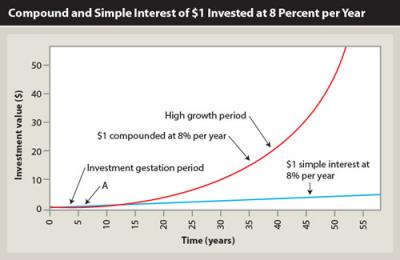
There is a concept in finance — the concept at the heart of many of the topics Arjit explains on his channel — called the compounding of returns. The idea that an investment that earns returns on its returns grows not linearly but exponentially over time.
Arjit’s channel is a demonstration of this principle in the domain of knowledge sharing.
Each video is an investment. It takes time to make, expertise to fill, and care to deliver well. But each video, once made, continues generating returns — views, subscriptions, trust, reach — indefinitely, because the search demand it serves does not expire.
Those returns compound: more views build more algorithm trust, which generates more distribution, which attracts more viewers, some of whom subscribe, who then watch older videos, which accumulates more watch time, which builds more algorithm trust.
The student who finds his channel today will watch not just the video they searched for but potentially dozens more — years of accumulated content available immediately, each video adding to the value the viewer receives from the channel. That concentrated value is what subscriptions are made of.
Three years ago, one student did not understand deferred tax liability. Arjit made a video. His cousin understood.
Then forty thousand students understood. Then one lakh. Then five lakh.
The video is still there. It still explains deferred tax liability clearly. The students keep finding it. The clarity keeps compounding.
That is the work. That is the opportunity.
Start making videos.
Written by Digital Drolia — celebrating the creators who build something real and lasting by simply explaining what they know with genuine care for the people who need to understand it. Found this valuable? Share it with someone who has expertise worth sharing and has not yet started.