
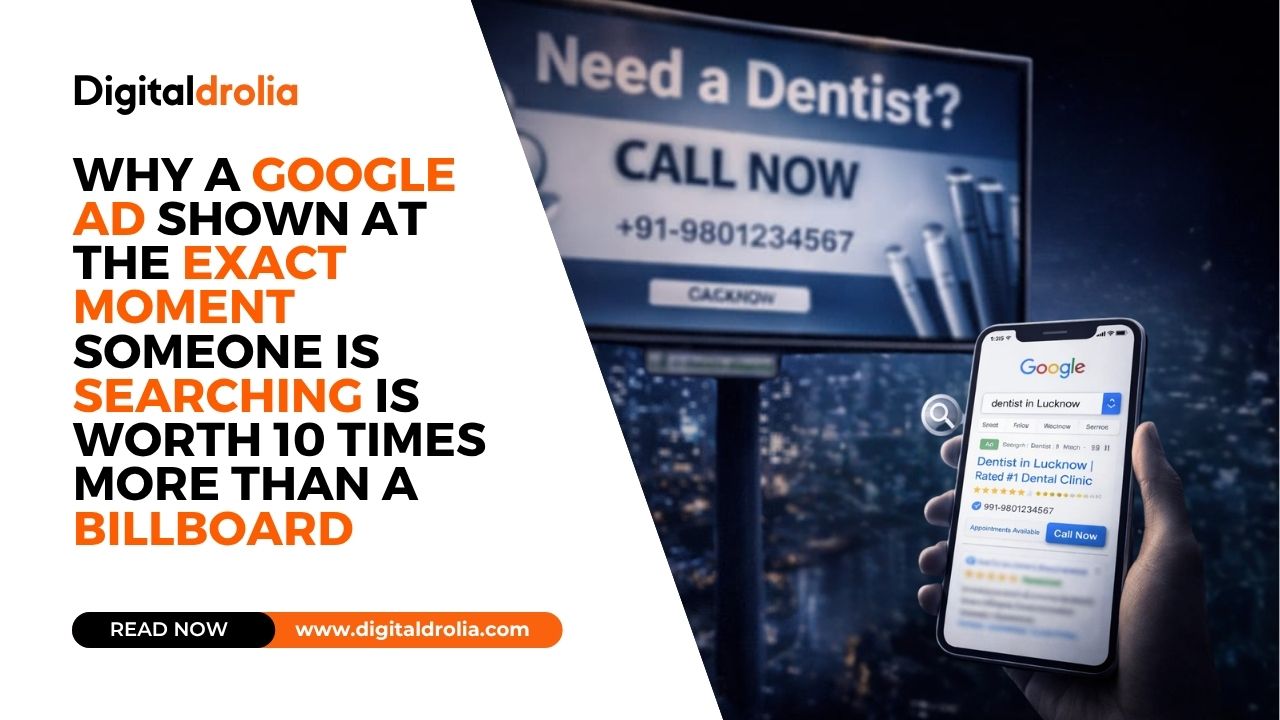
Why a Google Ad Shown at the Exact Moment Someone is Searching is Worth 10 Times More Than a Billboard

Let me ask you something that might seem obvious once you hear it — but that most people have never actually stopped to think about.
When you drive past a billboard advertising a new housing project, what are you doing?
You are driving. You are thinking about where you are going. You are possibly talking to someone in the car, or listening to music, or mentally running through your to-do list. You are not thinking about buying a flat. You are not in any state of readiness to engage with a property advertisement. The billboard exists in the physical world, but your attention — your actual cognitive attention — is somewhere else entirely.
Now contrast that with this moment.
It is a Sunday evening. You have been thinking for a few weeks that you might want to buy a flat — the lease on your current place is ending in six months, and the thought has been sitting in the back of your mind. Tonight, after dinner, you pick up your phone and type into Google: “2BHK flat for sale in Pune under 80 lakhs.”
In that moment, you are not driving. You are not distracted. You are not thinking about something else. You have specifically, deliberately, intentionally gone looking for information about buying a flat. Your attention is fully present. Your intent is explicit. Your decision-making mind is engaged and receptive.
Now imagine a Google Search Ad appears at the top of the results — a developer advertising 2BHK flats in Pune under 80 lakhs with a call button right there.
The difference between those two scenarios is not a matter of degree. It is a matter of kind. They are fundamentally different types of advertising moments — and understanding exactly why explains one of the most important truths in all of modern marketing.
The Attention Problem That Has Always Haunted Advertising

Advertising has existed in some form for as long as commerce has existed. And for most of that history, advertisers have faced one fundamental, inescapable problem.
They cannot control when their message is seen relative to when their audience actually needs what they are selling.
A billboard for a restaurant is seen by everyone who drives past — whether they are hungry or full, nearby or forty kilometres away, open to trying something new or deeply loyal to somewhere else. The advertisement has no way of knowing which of those things is true for each driver. It just broadcasts the same message to everyone and hopes the timing happens to work out for some small percentage of passers-by.
A television commercial for a car brand runs during a prime-time show. Millions of people see it. Some of them are in the market for a new car. Most of them are not — they bought one recently, they cannot afford one right now, they do not drive, they are happy with what they have. The commercial reaches all of them equally, regardless of relevance.
A newspaper ad for a travel agency runs on Tuesday. The people who are currently planning a holiday might respond. The people who went on holiday last week or who cannot travel for six months will read it and move on.
In every case, the advertiser is paying to reach a broad audience and hoping to catch the small subset of that audience for whom the message is relevant at that particular moment. This has always been the fundamental inefficiency of advertising — the gap between who sees the message and who actually needs it right now.
For most of advertising history, this inefficiency was simply accepted as unavoidable. There was no better way.
Then the internet arrived. And specifically, Google arrived. And suddenly, for the first time in the history of commerce, it became possible to advertise to people not based on who they are or where they are or what they might be interested in — but based on what they are actively looking for right now.
That changed everything.
What a Billboard Is Actually Selling You
To understand why the moment of search is so valuable, it helps to understand what different types of advertising are actually delivering — because most people conflate awareness, consideration, and purchase intent as if they were the same thing on a spectrum. They are not.
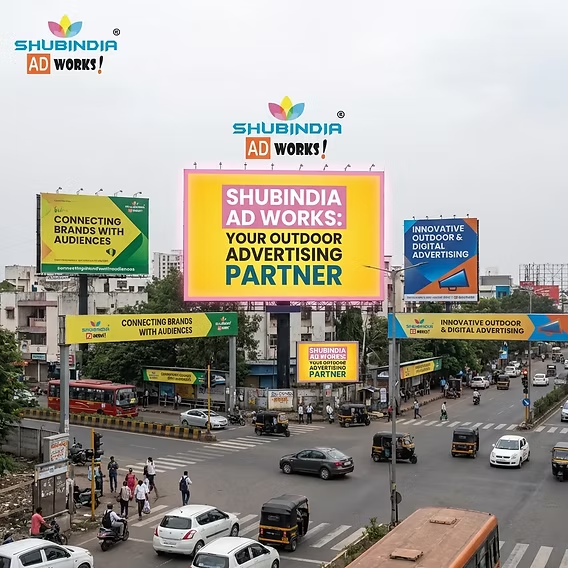
A billboard delivers one thing: visual exposure to a defined geographic audience.
It does not deliver intent. It does not deliver readiness. It does not deliver engagement. It delivers the fact that a certain number of people, driving or walking past a certain location, saw a visual message for a certain number of seconds.
This is not nothing. Repeated visual exposure builds brand familiarity over time. Familiarity builds a degree of trust. And in a market where purchase decisions are influenced by brand recognition — where someone choosing between two roughly equivalent options may favour the one they have seen more often — that familiarity has real value.
But it is a slow, indirect, statistically inefficient form of value creation. You spend significant money to generate familiarity in a broad audience, in the hope that when someone in that audience eventually reaches a relevant purchase moment, your brand will be at the top of their mind.
The gap between seeing the billboard and taking action could be days, weeks, months, or never.
And here is the part that makes billboard owners uncomfortable: you have almost no way of measuring whether the billboard is actually doing anything. You know how many vehicles pass it based on traffic counts. You do not know how many people looked at it, processed it, remembered it, or took any action as a result.
What a Google Search Ad Is Actually Delivering

Now let us be equally precise about what a Google Search Ad delivers.
When someone types a specific query into Google — “plumber near me,” “laptop under 50000,” “best physiotherapist in Chennai,” “divorce lawyer Bangalore” — they are doing something that has enormous informational value.
They are declaring intent.
They are saying, as clearly and explicitly as it is possible to say: I am looking for this, right now, in this context, with this level of urgency.
A person searching “emergency plumber near me” is not browsing. They have a burst pipe. They need someone now. A person searching “best laptop for college student under 50000” is comparison shopping. They are close to buying. A person searching “divorce lawyer Bangalore consultation” is in a situation that has driven them to seek specific professional help.
Each of these searches is a window into a real human need at a real moment in time. And Google Search Ads allow businesses to step into that window — to place their offer directly in front of the person expressing that need, in the precise moment they are expressing it.
The gap between seeing the ad and taking action is not days or weeks or months. It is seconds. The person is already in action mode. They have already decided to look for a solution. The ad is not interrupting them or persuading them to create a need they do not have. It is answering a need they have already declared.
This is not a small difference from billboard advertising. It is an enormous one. It is the difference between cold outreach to an uninterested audience and warm response to an expressed request.
The Intent Pyramid — Understanding Where Different Channels Sit
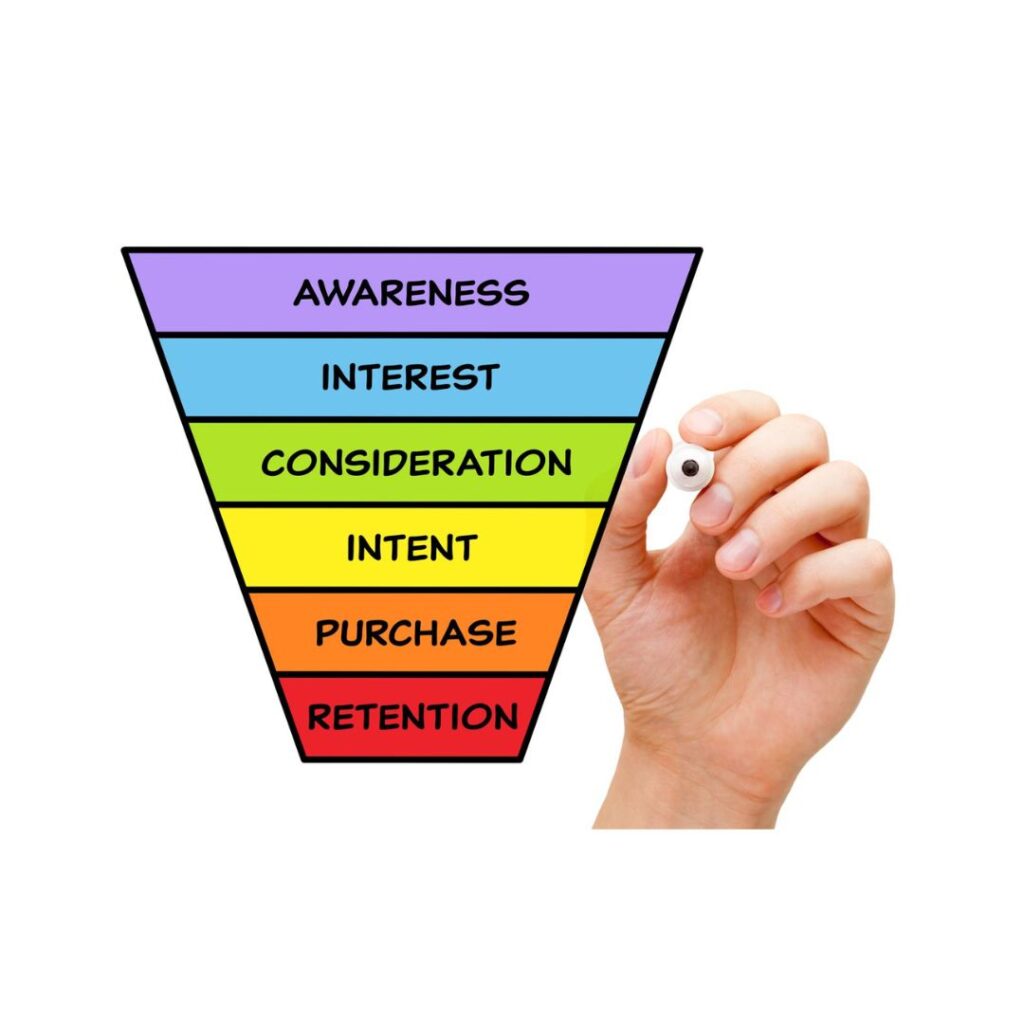
It helps to visualise advertising channels on what marketers sometimes call an intent pyramid.
At the very top of the pyramid — the smallest audience but the most valuable — are people in active purchase mode. They know what they want. They are actively looking for where to get it. They are ready to transact. Google Search captures this audience.
Just below that are people in active consideration mode. They have a need they are aware of and they are researching options. They might be searching Google for information, reading reviews, visiting comparison websites. Google Search also captures some of this audience — and Google Display retargeting can maintain visibility during this phase.
In the middle are people who are passively aware of a need. They know they should probably get around to solving something — buying a car, finding a dentist, renovating the kitchen — but they have not yet moved into active research mode. Social media advertising, YouTube advertising, and some display advertising can reach this audience.
At the base — the largest audience but the least valuable from a direct conversion standpoint — are people with no current relevant need at all. They are simply living their lives. Television, radio, billboards, and newspaper advertising primarily reach this audience. The hope is to build brand awareness so that when they eventually develop a relevant need, your brand is remembered.
Every level of this pyramid has legitimate marketing value. Brand awareness at the base is not worthless — it feeds the consideration and purchase layers above it over time.
But the relative value per rupee spent varies dramatically across the pyramid. An advertising rupee spent at the top — reaching someone in active purchase mode — consistently delivers more immediate, measurable return than a rupee spent at the base reaching someone with no current relevant need.
Google Search Ads operate at the top of the pyramid. Billboards operate at the base. And the distance between those two points is not a small gap in efficiency — it is the difference between throwing seed on concrete and planting it in prepared soil.
The Measurement Problem — Why Billboards Live on Faith
There is another dimension to this comparison that is worth exploring carefully because it has profound practical implications for businesses trying to grow.
Billboards are almost impossible to measure.
You can know, approximately, how many vehicles pass a particular hoarding each day based on traffic surveys. You can guess at how many of those vehicle occupants looked at it based on eye-tracking studies conducted in controlled environments. Beyond that, you are in the territory of assumptions and faith.
Did the billboard contribute to the sale that happened last Tuesday? There is no way to know with any certainty. The customer who came in and bought a car might have seen your billboard three times in the past month. Or they might have discovered you through a Google search. Or a friend recommendation. Or a visit to your showroom. The billboard might have contributed to their familiarity with the brand. Or it might have had nothing to do with it.
This unmeasurability is not just a philosophical inconvenience. It is a practical problem for business owners trying to make intelligent decisions about where to allocate limited marketing budgets. If you cannot measure whether something is working, you cannot improve it, optimise it, or make rational decisions about whether to continue investing in it.
You are operating on hope.
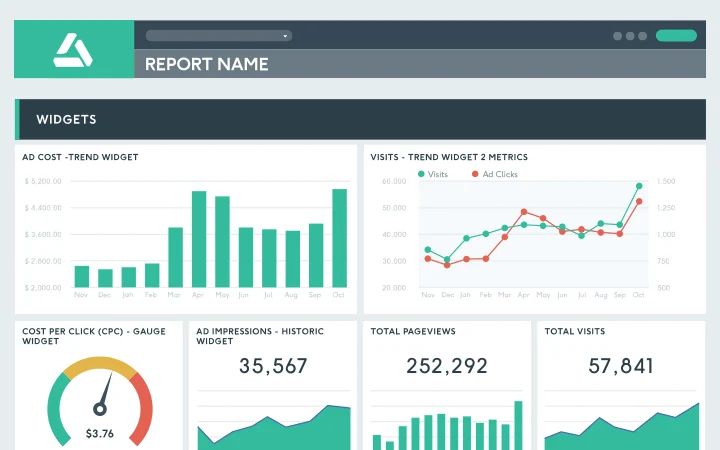
Google Search Ads are among the most measurable forms of advertising ever invented.
You know exactly how many times your ad was shown. You know exactly how many people clicked on it. You know the exact cost of each click. You know how many of those clicks resulted in a phone call, a form submission, a purchase, a booking. You know which specific keywords triggered the most conversions. You know what time of day, what day of the week, what device type produced the best results.
You can calculate, with precision, your cost per click, your cost per enquiry, your cost per acquisition, and your return on ad spend.
And because you know all of these things, you can improve. You can remove keywords that cost money but do not convert. You can increase bids on keywords that produce your best customers. You can adjust your ads to improve click-through rates. You can change your landing page to improve conversion rates. You can shift budget from underperforming campaigns to overperforming ones.
Every day that a Google Ads campaign runs produces data. Every piece of data is an opportunity to improve. The campaign you run after six months of continuous optimisation is dramatically more efficient than the campaign you ran on Day One.
A billboard does not improve. It displays the same image to the same audience in the same way until you change it or remove it.
The Sniper vs The Shotgun — A Metaphor That Clarifies Everything
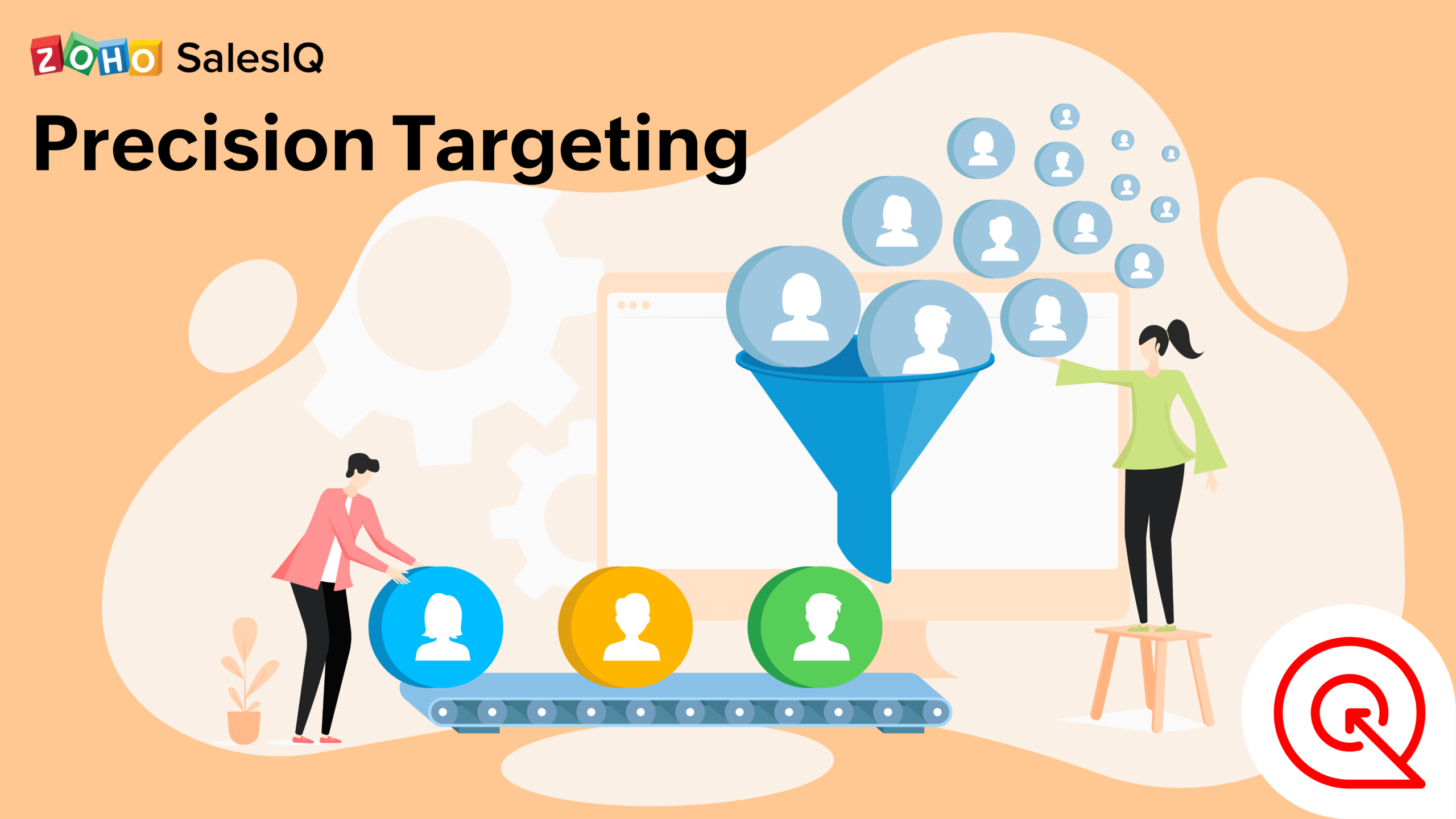
There is an old metaphor in marketing between the shotgun and the sniper rifle. It is a useful one here.
A shotgun fires a wide pattern of pellets. It is imprecise but covers a broad area. If your target is somewhere in that area, some pellets will hit it. But most of them will not — they will pass through empty space or hit things you did not intend to hit. The shotgun works by overwhelming coverage of an area with the hope of hitting something.
A sniper rifle fires a single, precisely aimed shot. It requires more knowledge, more preparation, more skill to aim correctly. But when aimed correctly, every shot hits the target.
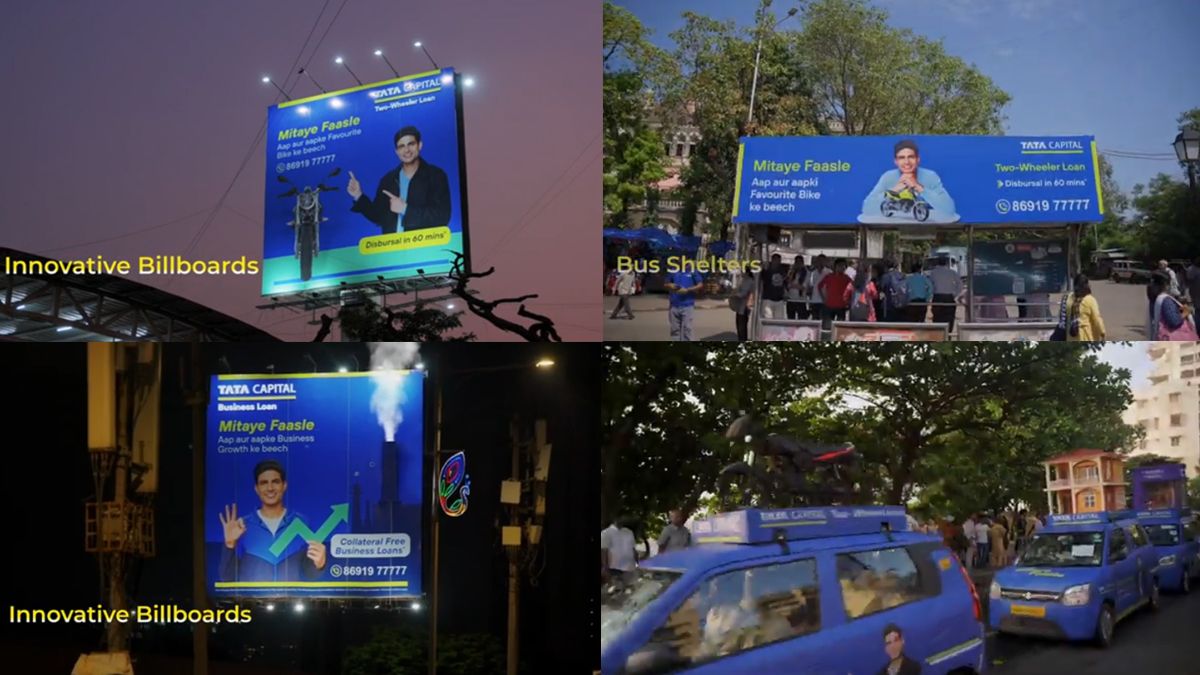
Billboard advertising is the shotgun. You fire your message broadly across a geographic area and hope that some percentage of the audience happens to be relevant. Most of the audience is irrelevant — but you have no way to fire only at the relevant ones, so you fire at everyone.
Google Search Advertising is the sniper rifle. You know exactly who you are targeting — someone who has typed a specific search query expressing a specific need. You aim at that person. You fire one shot. And because you are aiming at someone who is already looking for what you offer, the shot hits far more often than the shotgun pellets do.
The sniper rifle requires more thought — keyword research, ad copy, landing page design, bid management. The shotgun is easier to use — design a visual, pay for placement, done.
But in terms of impact per rupee spent? There is no comparison.
The Compounding Advantage of Data — Why the Gap Widens Over Time
Here is something that most people do not appreciate about Google Search Ads until they have been running them for several months.
The advantage does not stay constant over time. It compounds.
A billboard produces roughly the same result in Month Six as it does in Month One. You are paying for the same exposure to the same audience with the same message. The billboard does not learn from experience. It does not improve based on what worked last month.
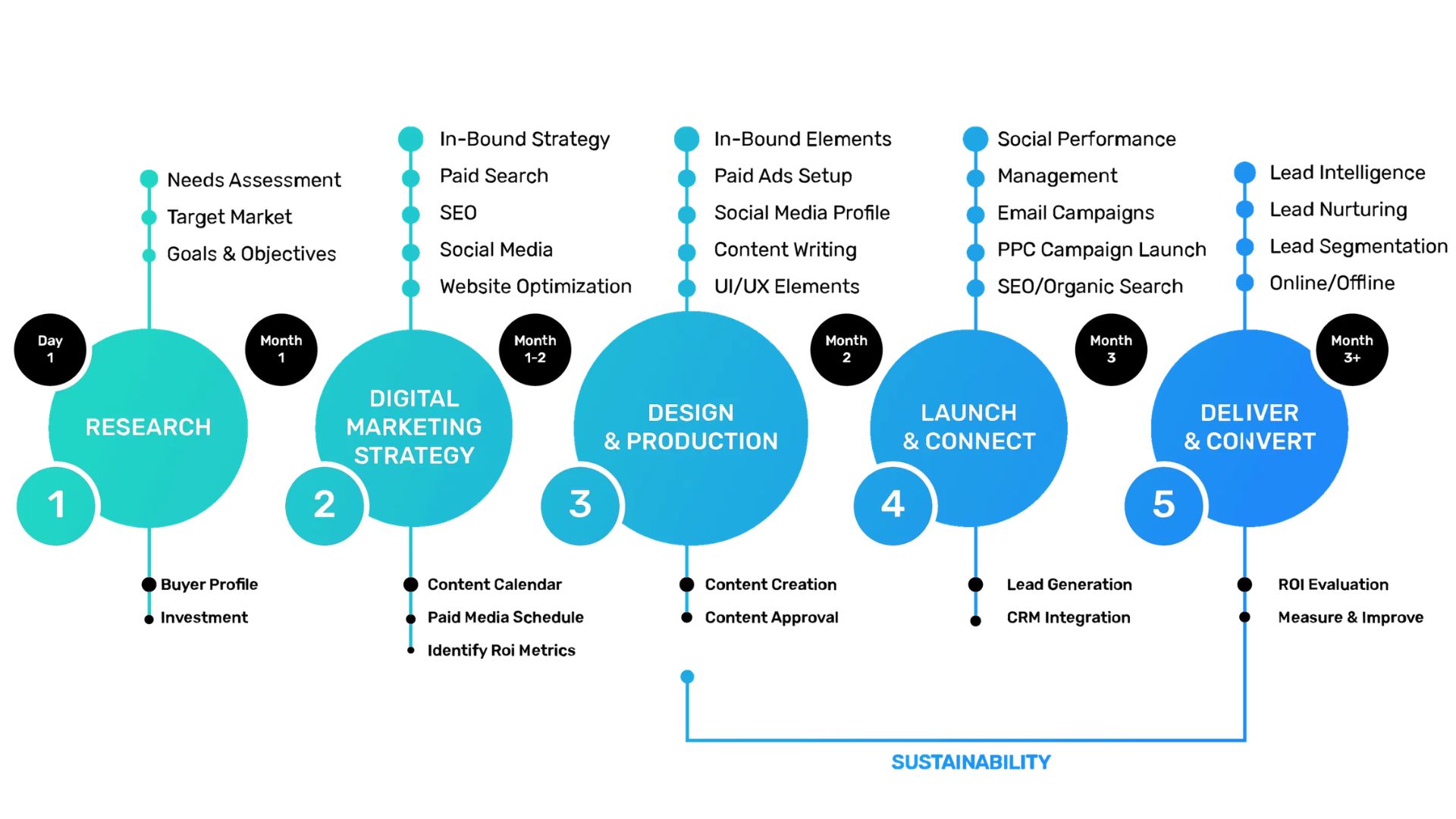
A Google Search Ads campaign is different. Every week that passes produces more data. More data enables better decisions. Better decisions produce better results. Better results reduce the cost per acquisition. Lower cost per acquisition means your budget goes further. Your budget going further means you can either maintain results for less money or scale results for the same money.
A business that has been running Google Search Ads intelligently for twelve months has a campaign that is dramatically more efficient than when it started. The negative keyword list is extensive — accumulated from months of identifying irrelevant queries. The bid strategy is refined — based on months of data about which keywords actually convert. The ad copy is battle-tested — the variations that performed best have been identified through systematic testing. The landing pages have been optimised based on real conversion data.
This accumulated intelligence is an asset that appreciates over time. It is a competitive advantage that is genuinely difficult for a late arrival to replicate quickly — because it has been earned through months of real-world data collection and iterative improvement.
The billboard has no such accumulation. It is as dumb on Day Three Hundred and Sixty-Five as it was on Day One.
When Billboards Still Have a Role — Honesty Matters Here
This post has made a strong case for Google Search Ads over billboards, and that case is genuine and evidence-based. But intellectual honesty requires acknowledging where billboard advertising retains legitimate value.
For very large brands building national or global awareness — the kind of awareness that takes years and billions of rupees to build — billboard advertising plays a role in maintaining the brand’s cultural presence. When you see a Tata or a Tanishq or an Amul hoarding, you are not expected to pull over and make a purchase. You are receiving a brand impression that accumulates over time into deep familiarity and trust. At that scale and with that long-term objective, billboard spending can be justified.
For businesses in categories where the purchase decision is heavily influenced by ambient brand visibility — certain FMCG products, some luxury goods, some political campaigns — the broad reach of outdoor advertising has strategic value.
For hyperlocal businesses in small markets where a single prominent hoarding can reach a very high percentage of the relevant local audience regularly — a highway hoarding for a dhaba visible to every trucker on a busy route, for example — outdoor advertising can be efficiently targeted by default simply because the audience is so concentrated.
And for businesses that are running Google Search Ads as their primary conversion channel, billboard advertising can serve as a secondary brand reinforcement tool — ensuring that when a potential customer does encounter the brand through search, they have already seen it in the physical world, which builds familiarity and trust.
The strongest position is usually not billboard or Google Ads. For businesses with sufficient budget, it is Google Ads primarily and billboards strategically — not billboard primarily and Google as an afterthought.
The Local Business Equation — Why This Matters Most for Small and Medium Businesses
Everything we have discussed so far applies universally, but it matters most — most urgently, most practically — for small and medium local businesses.
Large brands with enormous budgets can afford to run billboards, television, radio, digital, social, print, and every other channel simultaneously. They cover the entire intent spectrum at scale and accept that most of their spend is reaching irrelevant audiences at any given moment, because the sheer volume of coverage eventually pays off.
Small and medium businesses cannot do this. They have limited budgets. Every rupee they spend needs to work. Every campaign needs to justify itself. There is no room for the elegant inefficiency of brand building at scale.
For a physiotherapy clinic in Coimbatore with a monthly marketing budget of twenty thousand rupees — the difference between spending it on a hoarding that reaches everyone in a neighborhood and spending it on Google Search Ads that reach only people who are actively searching for a physiotherapist is enormous. The hoarding might generate a handful of calls from the small percentage of passers-by who happen to need physiotherapy right now. The Google Search Ads generate calls specifically from people who typed “physiotherapist near me” — who by definition need physiotherapy right now.
Same budget. Dramatically different quality of audience reached.
For a boutique hotel in Coorg with a marketing budget stretched thin across the year — the difference between a billboard on the highway and a Google Search campaign targeting people searching “resorts in Coorg for weekend” is the difference between advertising to everyone passing through and advertising to the specific people who are planning a trip to Coorg right now.
The math is different for every business. But for almost all local and regional businesses operating within real budget constraints, the math consistently favors the high-intent channel over the broad awareness channel.
The Moment Is the Message
Marshall McLuhan famously said the medium is the message — the idea that the form of a medium embeds itself in its message, shaping how the content is received.
In digital advertising, something related but distinct is true: the moment is the message.
The moment at which an advertisement is encountered determines more about its effectiveness than almost anything else — more than the quality of the creative, more than the precision of the targeting, more than the size of the budget.
An ad for running shoes encountered while you are sitting on a bus thinking about nothing in particular is worth very little, regardless of how beautifully it is designed.
An ad for running shoes encountered at the exact moment you have typed “best running shoes for beginners under 5000” into Google is worth enormously more — because the moment has already done the motivational work. The need has been expressed. The search has been initiated. All the ad needs to do is confirm relevance and provide a path forward.
This is why a Google Ad shown at the exact moment someone is searching is worth ten times more than a billboard. Not because Google Ads are cleverly designed. Not because the words are better chosen. Not because the images are more compelling.
Because the moment is different.
The billboard exists in a moment of distraction. The search ad exists in a moment of intent.
And in the economy of human attention — the most valuable and most finite resource in modern marketing — the moment of intent is worth everything.
What This Means for You — Practically, Today
If you are a business owner reading this and you are currently spending marketing budget on outdoor advertising, print, or broad awareness channels without any investment in Google Search — here is the simple, direct implication.
You are paying to reach people who are not looking for you. And there are people who are looking for you right now — typing search queries that describe exactly what you offer — who are not finding you because you are not there.
That is an expensive gap.
Not expensive because of what you spend. Expensive because of what you miss.
Starting a Google Search Ads campaign does not require abandoning other channels. It does not require a large budget to begin. It does require knowledge, time, and the willingness to monitor and optimise consistently.
But once built and running well, it is the closest thing to a reliable, measurable, continuously improving customer acquisition engine that exists in modern marketing.
The billboard will keep displaying its image to unaware drivers.
Meanwhile, your Google ad will be waiting — precisely positioned, carefully targeted, ready to appear — at the exact moment a real person with a real need asks Google for help finding someone like you.
That moment is not worth ten times more than a billboard because of any cleverness in the technology.
It is worth ten times more because the human being on the other end of that search has already done the most important work in marketing.
They have decided they want what you offer.
All you have to do is be there when they look.
Written by Digital Drolia — practical digital marketing thinking for businesses that want to grow intelligently. Found this valuable? Share it with a business owner who is still spending their entire marketing budget on channels that reach people who are not looking for them.