


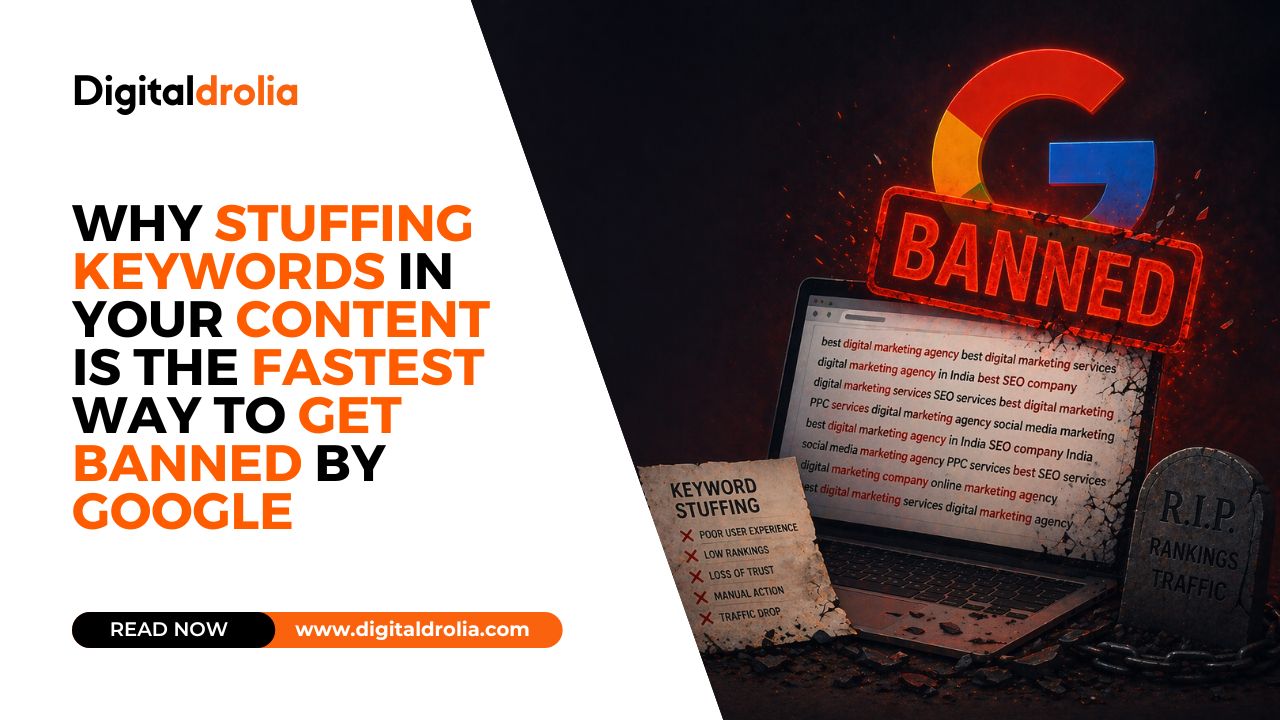
Why Stuffing Keywords in Your Content is the Fastest Way to Get Banned by Google

Let me tell you about Priya’s nightmare.
She runs a small boutique in Mumbai selling handmade jewelry. In 2023, she hired a “digital marketing expert” who promised to get her website to rank #1 on Google in just two weeks. The secret? “Aggressive SEO optimization.”
What this “expert” actually did was stuff her website content with keywords until it read like a robot having a meltdown. Her homepage looked like this:
“Buy handmade jewelry Mumbai. Handmade jewelry Mumbai best prices. Looking for handmade jewelry in Mumbai? We sell handmade jewelry Mumbai for women. Our handmade jewelry Mumbai collection includes handmade jewelry Mumbai necklaces, handmade jewelry Mumbai earrings, and handmade jewelry Mumbai bracelets. Contact us for handmade jewelry Mumbai today!”
Painful to read, right? Google thought so too.

Within three weeks, her website disappeared from Google search results entirely. Not page two. Not page ten. Gone. Completely de-indexed. Years of work building her online presence, erased.
It took her six months and ₹3 lakhs to recover from that penalty. And some of her rankings never fully came back.
This isn’t a unique story. Every single day, thousands of websites get penalized or banned by Google for keyword stuffing. The tragedy? Most people doing it have no idea they’re destroying their own business until it’s too late.
In this post, I’m going to show you exactly why keyword stuffing is digital suicide, how Google catches you (it’s easier than you think), what happens when you get caught, and most importantly—how to optimize for search engines the right way, without risking everything you’ve built.
What Exactly is Keyword Stuffing? (And Why People Still Do It)
Keyword stuffing is the practice of overloading your web content with target keywords in an unnatural, excessive way, solely to manipulate search engine rankings.

It comes in many forms:
Obvious stuffing: Repeating the same keyword or phrase over and over in your content, like Priya’s example above.
Hidden stuffing: Using white text on a white background, hiding keywords behind images, or stuffing keywords into HTML code where users can’t see them but search engines can.
Irrelevant stuffing: Loading your page with popular keywords that have nothing to do with your actual content (like a dentist’s website mentioning “iPhone 15” just because it’s trending).
Footer/sidebar stuffing: Cramming dozens or hundreds of keyword variations into your website footer or sidebar.
Meta tag stuffing: Overloading meta tags, alt tags, and title tags with excessive keywords.
Doorway pages: Creating low-quality pages optimized for specific keywords that just redirect users to your main page.
Here’s a real example I found on a website last week (slightly modified to protect the guilty):
“If you’re searching for the best digital marketing agency in Delhi, look no further. Our digital marketing agency Delhi team provides digital marketing services Delhi including SEO Delhi, social media marketing Delhi, content marketing Delhi, and PPC Delhi. As the top digital marketing agency in Delhi NCR, our digital marketing company Delhi has helped businesses with digital marketing solutions Delhi for over 10 years. Contact our digital marketing experts Delhi today for digital marketing consultation Delhi.”
Count the keyword repetitions. It’s exhausting, isn’t it?

Why Do People Still Do This in 2024?
If keyword stuffing is so dangerous, why do people keep doing it? A few reasons:
1. Outdated advice. Many “SEO gurus” are still teaching tactics from 2005. Back then, keyword stuffing actually worked. Search engines were primitive and could be easily gamed.
2. Desperation for quick results. Business owners want to rank fast. Keyword stuffing feels like a shortcut (spoiler: it’s not).
3. Ignorance. Many people genuinely don’t know this is wrong. They think “more keywords = better rankings” sounds logical.
4. Cheap SEO services. When you hire someone for ₹5,000/month to “do your SEO,” they often resort to spammy tactics because they don’t have time or skill for legitimate strategies.
5. It occasionally works… temporarily. Sometimes keyword-stuffed content does rank for a few weeks before Google catches it. This creates a false sense of success.
But make no mistake: Google always catches up. And when it does, the consequences are severe.
How Google Actually Detects Keyword Stuffing (Spoiler: It’s Terrifyingly Good at It)
“But I’m just a small website. Google has billions of pages to crawl. How would they even notice me?”
This is what people tell themselves before they get slapped with a penalty.
Here’s the uncomfortable truth: Google is exceptionally good at detecting unnatural content. Here’s how:




1. Natural Language Processing (NLP) and AI
Google doesn’t just count keywords anymore. It understands language.
Its AI models (like BERT and MUM) actually comprehend what your content means, just like a human reader would. They analyze:
- Keyword density: If your keyword appears in 5%+ of your total words, that’s a red flag. Natural writing rarely exceeds 1-2%.
- Synonym usage: Natural content uses variations and synonyms. Keyword-stuffed content repeats the exact same phrase obsessively.
- Context and coherence: Does your content flow naturally? Does it make sense? Or does it read like you’re trying to game the system?
- User intent match: Does your content actually address what someone searching that keyword needs? Or are you just repeating words hoping to rank?
Google’s AI can literally “read” your content and determine whether it was written for humans or for search engines. And it’s incredibly accurate.
2. User Behavior Signals
Even if you somehow fooled Google’s algorithms initially, user behavior exposes you quickly:
- Bounce rate: If people land on your keyword-stuffed page and immediately hit the back button (because it’s unreadable), Google notices.
- Time on page: Natural, engaging content keeps people reading. Keyword-stuffed garbage doesn’t.
- Click-through rate: If your search listing has a keyword-stuffed title and meta description, fewer people click it. Google interprets this as low quality.
- Return to search: When users click your result, get frustrated, and immediately search again for the same thing, Google knows your content didn’t satisfy them.
These behavioral signals are incredibly powerful. They’re the real-world proof that your content is spam.
3. Manual Reviews
Google employs thousands of quality raters worldwide who manually review websites and report spam. If your keyword stuffing is egregious enough, a human will see it and flag it.
Additionally, your competitors or annoyed users can report you directly through Google’s spam report form. If you’re blatantly violating guidelines, someone will eventually report you.
4. Algorithmic Updates
Google releases hundreds of algorithm updates each year. Many specifically target spammy tactics like keyword stuffing.
Major updates like:
- Panda (2011): Targeted low-quality, thin content
- Penguin (2012): Targeted manipulative SEO tactics
- Helpful Content Update (2022-2024): Rewards content written for people, not search engines
- Spam Updates (ongoing): Continuously identify and demote spammy content
Each update refines Google’s ability to detect manipulation. What might slip through today could get caught tomorrow.

5. Machine Learning that Gets Smarter Over Time
Here’s the scariest part: Google’s AI learns from every website it crawls, every user interaction, every spam report.
This means detection gets better constantly. A tactic that worked last month might trigger a penalty this month. The system is always improving, always getting harder to fool.
What Happens When Google Catches You (It’s Worse Than You Think)
So what actually happens when Google determines you’re keyword stuffing? The consequences range from bad to catastrophic:

Level 1: Ranking Drops
The mildest penalty is a significant drop in rankings. Your page that was ranking #5 might drop to #30 or #50. You’ll lose most of your organic traffic overnight.
This can happen algorithmically (automatically) without any notification. You just wake up one day and your traffic has tanked.
Level 2: Page-Level Penalties
Google might penalize specific pages on your site while leaving others alone. The offending pages get deindexed or pushed so far down they’re effectively invisible.
You’ll see this in Google Search Console as a sudden drop in impressions and clicks for certain pages.
Level 3: Site-Wide Manual Actions
This is serious. A manual action means a human reviewer at Google looked at your site and determined it violates their guidelines.
You’ll get a notification in Google Search Console explaining the violation. Your entire website’s rankings will plummet. You might even get completely removed from search results.
To recover, you need to:
- Fix all the issues Google identified
- Submit a reconsideration request
- Wait weeks or months for review
- Hope they accept your appeal (they often don’t on the first try)
Level 4: Complete Deindexing
This is the death sentence. Your website is completely removed from Google’s index. It literally doesn’t exist in Google search anymore.
Type “site:yourwebsite.com” in Google and you’ll see zero results. Terrifying.
Recovery from complete deindexing is possible but difficult and time-consuming. Some websites never fully recover.
The Real Cost Beyond Rankings
Rankings and traffic aren’t the only things you lose:
Lost revenue. If you’re an e-commerce site or depend on organic traffic for leads, a Google penalty directly impacts your income. We’re talking thousands or lakhs in lost revenue per month.
Damaged reputation. Being labeled as spam by Google hurts your brand’s credibility. Even after recovery, some customers will remember.
Wasted investment. All the money you spent on content, SEO, website development—partially or completely wasted.
Opportunity cost. While you’re fighting to recover from a penalty, your competitors are growing. They’re capturing market share you’ll never get back.
Stress and uncertainty. The anxiety of not knowing if or when you’ll recover is brutal for business owners.

Real Examples of Keyword Stuffing Disasters
Let me share some real cases (details changed to protect identities):

Case 1: The E-commerce Store
An online store selling electronics stuffed product descriptions with keywords. Every product page mentioned “buy online India best price cheap” dozens of times.
After a Google update, they lost 90% of organic traffic overnight. Revenue dropped from ₹5 lakhs/month to ₹50,000/month. It took them 8 months to recover, during which they had to lay off staff and nearly shut down.
Case 2: The Local Service Business
A plumber in Bangalore hired a cheap SEO agency that created doorway pages for every neighborhood: “plumber in Koramangala,” “plumber in Indiranagar,” etc. Each page was 95% identical with just the neighborhood name swapped.
Google hit them with a manual penalty. They lost all local rankings. Their phone stopped ringing. They had to spend ₹2 lakhs hiring a legitimate SEO consultant to clean up the mess.
Case 3: The Blogger Who Thought He Was Smart
A tech blogger read that “keyword density should be 3-5%” (outdated advice from 2008). He religiously hit 4% keyword density on every post.
His traffic grew for six months, then suddenly crashed. Google’s Helpful Content Update destroyed his site. His traffic went from 50,000 visits/month to 3,000. He lost all his affiliate income and advertising revenue.
He had to completely rewrite hundreds of blog posts to sound natural again. A year later, he’s still not back to his previous traffic levels.
The Right Way to Use Keywords (Without Killing Your Rankings)
Okay, enough horror stories. Let’s talk about how to actually optimize your content for search engines without risking penalties.
1. Write for Humans First, Search Engines Second
This is the golden rule. If your content reads naturally and provides genuine value to human readers, you’re 90% of the way there.
Ask yourself:
- Would I enjoy reading this?
- Does this sound like natural speech or writing?
- Am I embarrassed to show this to customers?
If your content feels forced or awkward, rewrite it.
2. Use Keywords Naturally and Sparingly
Instead of obsessing over keyword density, focus on natural inclusion:
In your title: Include your main keyword once in a natural, compelling way. Good: “10 Proven Strategies to Grow Your Instagram Following” Bad: “Instagram Following Growth | Grow Instagram Following | Instagram Followers Increase”
In your introduction: Mention your keyword naturally in the first 100 words.
In subheadings: Use variations of your keyword in some (not all) H2 and H3 tags.
Throughout the body: Let keywords appear naturally as you discuss the topic. Don’t force them.
In your conclusion: Mention the keyword once if it fits naturally.
A good rule of thumb: 1-2% keyword density maximum. For a 1,000-word article, that’s 10-20 mentions of your keyword or close variations. Not 50. Not 100.
3. Use Synonyms and Related Terms
Google understands semantic relationships. Instead of repeating “digital marketing” 50 times, mix it up:
- Digital marketing
- Online marketing
- Internet marketing
- Digital advertising
- Online promotion
- Digital strategy
This is called Latent Semantic Indexing (LSI). It helps Google understand your topic comprehensively while making your content more natural to read.

4. Focus on Topic Coverage, Not Keyword Frequency
Modern SEO is about thoroughly covering a topic, not repeating a keyword.
If you’re writing about “how to train a puppy,” don’t just repeat that phrase. Cover:
- Crate training
- Socialization
- Basic commands
- House training
- Dealing with biting
- Establishing routines
Google will recognize you’ve comprehensively addressed the topic and rank you accordingly. You don’t need to stuff “how to train a puppy” into every paragraph.
5. Optimize Meta Elements Properly
Title tag: 50-60 characters, include your main keyword once, make it compelling. Example: “Puppy Training Guide: 7 Essential Steps for New Owners”
Meta description: 150-160 characters, include keyword naturally, focus on enticing clicks. Example: “Learn proven puppy training techniques from professional dog trainers. Get your new puppy off to the best start with our comprehensive guide.”
Alt tags for images: Describe what’s actually in the image, include keywords when relevant. Example: “Golden retriever puppy learning to sit during training session”
Notice: natural language, keywords included organically, focused on being useful.
6. Create Genuinely Valuable Content
The best SEO strategy is creating content so good that people:
- Read it thoroughly
- Share it on social media
- Link to it from their websites
- Bookmark it for later
- Come back to it repeatedly
These signals tell Google: “This content is valuable.” You’ll rank well naturally, without manipulation.
Ask yourself:
- Does this answer the user’s question completely?
- Is this more helpful than what’s currently ranking?
- Would I share this with a friend?
If yes to all three, you’re on the right track.
7. Use Structured Data and Semantic Markup
Instead of stuffing keywords, help Google understand your content through proper markup:
- Schema.org structured data
- Proper HTML hierarchy (H1, H2, H3 tags used logically)
- Descriptive anchor text for links
- Organized content structure
This technical SEO is more effective than keyword stuffing and carries zero risk.
How to Audit Your Content for Keyword Stuffing (Before Google Does)
Worried you might have overdone keywords in your existing content? Here’s how to check:

DIY Audit Methods
1. Read it aloud. Seriously. Read your content out loud. Does it sound natural? Or does it sound like you’re repeating the same phrase obsessively? Your ears will catch what your eyes miss.
2. Use free keyword density checkers. Tools like:
- SEOBook Keyword Density Analyzer
- Internet Marketing Ninjas Keyword Density Tool
- WordCounter.net
If your main keyword appears more than 2% of the time, you probably need to tone it down.
3. Check Google Search Console. Look for:
- Pages with declining traffic
- Manual action notifications
- Sudden drops in impressions or rankings
These can indicate Google has identified issues.
4. Use the “Ctrl+F” test. Open your page and search for your main keyword. If it’s highlighted dozens of times on a single page, that’s a problem.
5. Get an outsider’s opinion. Ask someone unfamiliar with your business to read your content. If they say “this sounds weird” or “why do you keep repeating that phrase?”—you have keyword stuffing.

Warning Signs You’re in Danger
- Keyword density above 2-3%
- Exact same keyword phrase repeated more than once per paragraph
- Awkward, unnatural sentence construction
- Content that reads like a robot wrote it
- Multiple pages on your site with nearly identical content (just keyword swapped)
- Keywords in places they don’t belong (shoved into sentences where they don’t fit)
If you see these signs, it’s time to rewrite before Google notices.
How to Recover if You’ve Already Been Penalized
Already got hit with a penalty? Don’t panic. Recovery is possible, but it requires work.

Step 1: Confirm the Penalty
Check Google Search Console for:
- Manual action notifications
- Sudden traffic drops in Analytics
- Pages dropping out of search results
Identify which pages are affected and what Google says the violation is.
Step 2: Audit and Clean
Go through every page Google flagged (or your entire site if it’s a site-wide penalty) and:
- Remove excessive keywords
- Rewrite content to sound natural
- Delete low-quality doorway pages
- Fix meta tags and alt text
- Remove hidden text or other black-hat tactics
Don’t just reduce keywords slightly. Make the content genuinely good, genuinely natural.
Step 3: Submit Reconsideration Request (if it’s a manual action)
Once you’ve fixed everything:
- Document all changes you made
- Be honest about what you did wrong
- Explain how you’ve fixed it
- Submit a reconsideration request through Search Console
Be patient. Google can take weeks to review your request.
Step 4: Be Patient and Consistent
For algorithmic penalties (no manual action notification), recovery happens when:
- You’ve fixed the issues
- Google recrawls your pages
- The next algorithm update runs
This can take 3-6 months. Continue creating high-quality, natural content during this time.

Step 5: Monitor and Prevent Recurrence
Once you recover:
- Audit your content regularly
- Never go back to keyword stuffing
- Educate anyone working on your website about proper SEO
- Focus on quality over keyword optimization
Modern SEO: What Actually Works in 2024
Let me give you the good news: modern SEO is actually easier and more intuitive than old-school keyword stuffing ever was.

Here’s what Google actually rewards today:
1. Expertise and Authority Create content that demonstrates genuine knowledge. Cite sources. Share real experience. Be credible.
2. Comprehensive Topic Coverage Don’t write thin 300-word posts. Create in-depth resources that thoroughly address user questions.
3. User Experience Fast loading speed, mobile optimization, clear navigation, readable formatting—these matter more than keyword density.
4. Natural Backlinks Links earned because your content is valuable, not bought or manipulated.
5. User Engagement Content that people actually read, share, and find helpful.
6. Freshness Regular updates to keep content current and accurate.
7. Intent Matching Understanding what users actually want when they search and delivering exactly that.
None of this requires keyword stuffing. In fact, keyword stuffing actively hurts all of these factors.
The Mental Shift You Need to Make

Here’s the mindset change that separates successful modern marketers from those stuck in 2005:
Old SEO thinking: “How can I manipulate Google to rank my page?”
New SEO thinking: “How can I create content so valuable that it deserves to rank?”
Old SEO: Keywords, keywords, keywords
New SEO: User intent, value, quality
Old SEO: Quantity (stuff as many keywords as possible)
New SEO: Quality (make every word count)
Old SEO: Tricks and shortcuts
New SEO: Sustainable, long-term strategy
When you make this mental shift, SEO becomes less about gaming the system and more about genuinely serving your audience. And ironically, that’s when you’ll see the best results.
Final Thoughts: Play the Long Game

I started this post with Priya’s story. Here’s how it ended:
After recovering from her penalty, she completely changed her approach. She stopped trying to game Google and started creating genuinely helpful content:
- Jewelry care guides
- Style advice for different occasions
- Behind-the-scenes looks at her crafting process
- Customer stories and testimonials
She stopped obsessing over keywords and focused on being helpful.
Within a year, her organic traffic was 3x higher than before the penalty. Her conversion rate doubled because people trusted her expertise. She built a loyal audience who shares her content and recommends her to friends.
The penalty, as painful as it was, taught her the right way to do digital marketing.
You can learn from her mistake without experiencing the pain yourself.
Keyword stuffing is a shortcut that leads off a cliff. It might seem to work briefly, but the crash is inevitable and devastating.

The right path—creating genuinely valuable, naturally written content—takes longer. But it builds something sustainable. Something Google rewards. Something your audience loves.
Which path will you choose?
I hope you choose wisely. Your business depends on it.
Remember: Google gets smarter every day. The shortcuts get riskier every day. But creating genuine value? That never goes out of style.
Stop stuffing keywords. Start serving your audience. Your rankings (and your business) will thank you.